What the law says, in short
Egypt’s Personal Data Protection Law No. 151 of 2020 sets rules for collecting and processing personal data. Health data is treated as sensitive data, which needs extra care. The main ideas are familiar from privacy laws elsewhere:
- Collect data for a clear purpose, with the person’s consent where required.
- Use it only for that purpose and keep only what you need.
- Keep it accurate and secure.
- Do not share or transfer it without a legal basis.
- Respect the patient’s right to know what you hold and to correct it.
Other Arab countries have similar laws, for example Saudi Arabia’s Personal Data Protection Law and the UAE’s federal data protection law.
A practical checklist for the clinic
People and access
- One login per person. Never share a reception login. Without individual logins you cannot know who did what.
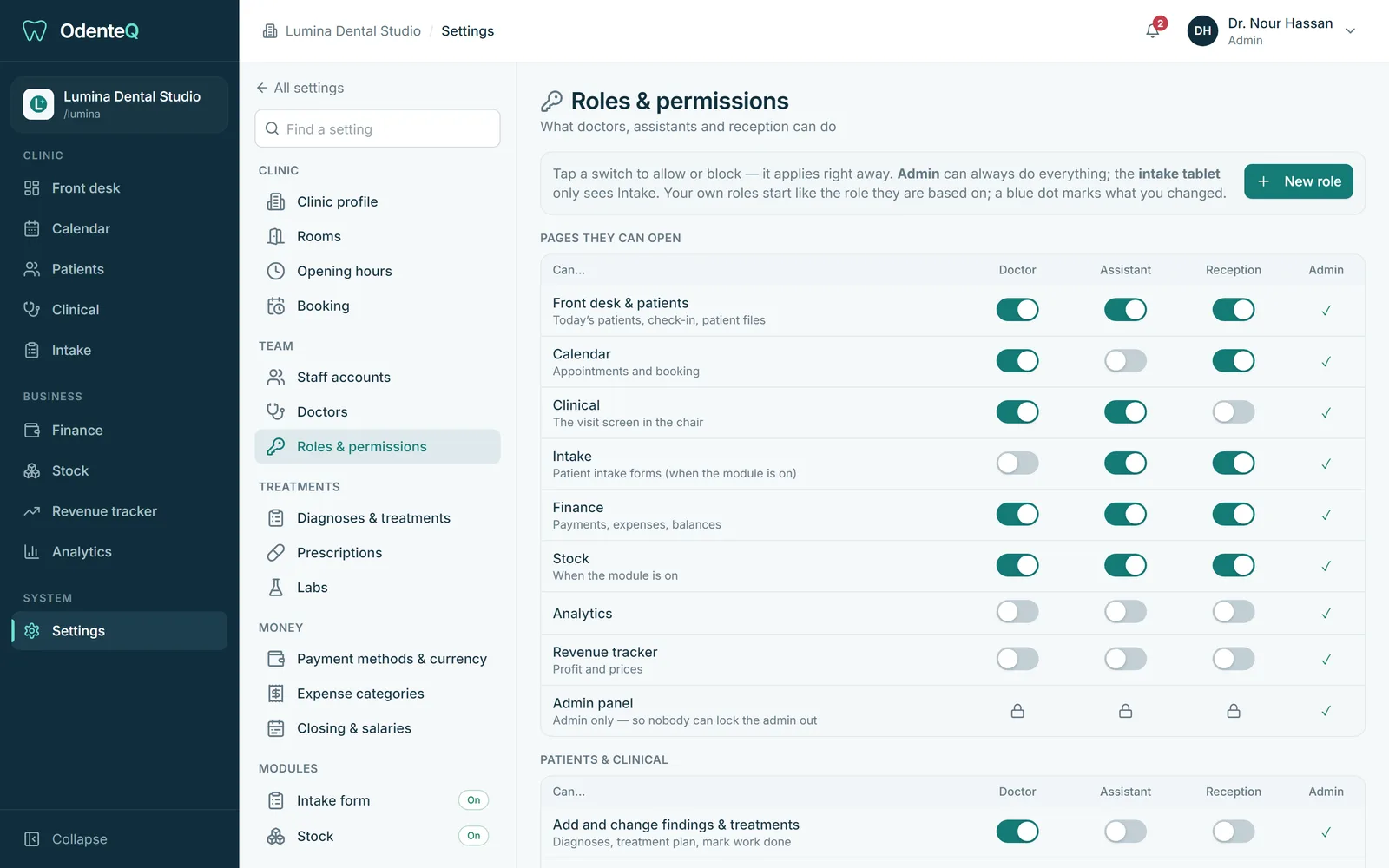
- Access by role. Reception does not need salaries. Assistants do not need the clinic’s profit. Give each role only what it needs.
- Remove access on the last day. When someone leaves, deactivate their account the same day.
- Keep an activity log of who changed what and when.
Consent and forms
- Ask patients to fill in and sign their medical history, with a short consent text explaining how you use their data.
- Get written consent before using photos (including before-and-after) on social media or your website.
Devices and files
- Lock screens and phones used for clinic work.
- Do not keep X-rays and patient photos in staff members’ personal phone galleries. Upload them to the patient file and delete the copy.
- Avoid USB sticks and personal e-mail for patient files.
WhatsApp is how patients reach clinics in Egypt. Use the clinic’s own number, not a doctor’s personal one, keep messages short and avoid sending detailed medical information unless the patient asked for it.
Backups and continuity
- If your records are on one PC, you need regular backups stored somewhere else.
- With cloud software, ask the provider how and how often data is backed up.
Choosing software
Ask every provider:
- Is each clinic’s data separated, and how?
- Is data encrypted in transit and at rest?
- Can you set permissions per role and see an activity log?
- Can you export all your data at any time?
- Will they ever sell or share your data?
How OdenteQ protects patient data
In OdenteQ, each clinic’s data is separated at the database level, so staff of one clinic can never reach another clinic’s data. Every person has their own login, permissions are set per role, salaries and payouts are visible only to the people you choose, every change is in the activity log, data is encrypted in transit and at rest, and you can export your patients whenever you want. We never sell or share your data.
Questions
Is there a data protection law in Egypt?
Yes. Egypt’s Personal Data Protection Law No. 151 of 2020 regulates personal data, and treats health data as sensitive data that needs extra protection.
Can a dental clinic send X-rays to patients on WhatsApp?
Many clinics do when the patient asks. Use the clinic’s own number, send only what the patient requested, and keep the original in the patient file rather than on staff phones.