The three common models
| Model | How it works | Best for |
|---|---|---|
| Fixed salary | The dentist gets the same amount each month | New graduates, clinics that want predictable costs |
| Percentage | The dentist gets a share of what their patients paid | Associates and visiting specialists |
| Profit share | Partners split what is left after all costs and commissions | Owners and partners |
Many clinics mix them: the owner on profit share, two associates on percentage, a new graduate on salary.
Billed or collected?
This is the most important choice.
- On billed work, the dentist is paid when the treatment is done, even if the patient has not paid yet. The clinic carries the risk of unpaid balances.
- On collected money, the dentist is paid from what patients actually paid that month. If a patient pays a treatment over four months, the commission arrives over four months.
Most clinics in Egypt and the Gulf pay on collected money. It is fair to both sides: the clinic never pays commission on money it did not receive, and the dentist gets paid as soon as the patient pays.
Before or after the lab fee?
For crowns, bridges, dentures, aligners and implants, the lab or the implant parts can be a large part of the price. If the commission is calculated on the full price, the clinic pays the dentist a percentage of the lab’s money too.
So most clinics take the lab fee off first:
Worked examples
Example 1: a crown paid in full. Price 10,000. Lab fee 2,000. Dentist on 40%. (10,000 − 2,000) × 40% = 3,200 to the dentist. The clinic keeps 4,800 to cover materials, rent, salaries and profit.
Example 2: the same crown paid in two months. The patient pays 6,000 in March and 4,000 in April. The lab fee is taken off the first payment.
- March: (6,000 − 2,000) × 40% = 1,600
- April: 4,000 × 40% = 1,600
Total 3,200, the same as example 1, but paid as the money comes in.
Example 3: a filling with no lab. Price 1,500, dentist on 35%. 1,500 × 35% = 525.
Profit share for partners
For partners, the calculation runs at the end of the month:
- Total money received
- Minus expenses (materials, rent, utilities, staff salaries)
- Minus lab payments
- Minus commissions paid to percentage dentists
- What is left is split between partners by their agreed share
Payment method fees
If a wallet or card charges a fee, decide who pays it. A common choice is to add the fee on top of what the patient pays, so it never reduces the dentist’s or the clinic’s share.
Mistakes that cause disputes
- No list behind the number. A dentist should see every payment that makes up their commission.
- Lab fees entered late or not at all. The commission is then too high, and correcting it next month causes arguments.
- Discounts not agreed. Decide in the contract whether discounts reduce the dentist’s share.
- Paying on billed work, then the patient never pays. Agree what happens to unpaid balances.
- Excel formulas that break. One wrong cell can change a payout without anyone noticing.
Doing it automatically
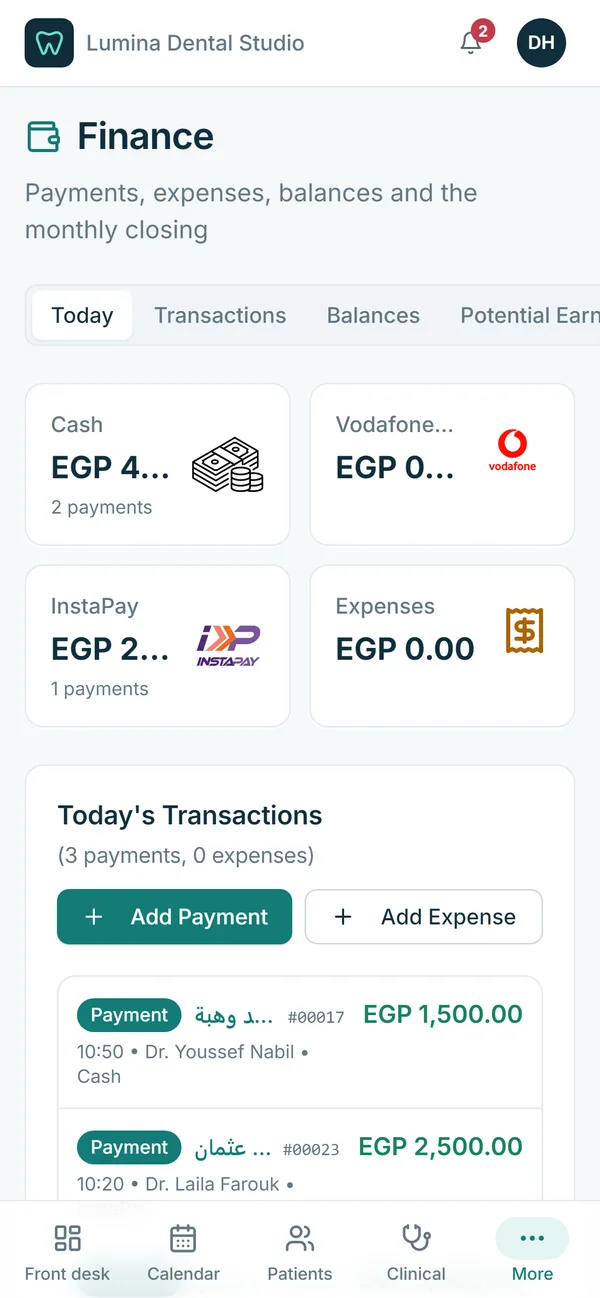
In OdenteQ, each dentist is set as salary, percentage or profit share once. The monthly closing calculates each payout from real payments minus lab fees, shows the full list of payments behind it, and lets the owner confirm, adjust with a comment and print. Each dentist sees only their own earnings.
Questions
What percentage do dentists get in Egypt?
It varies by clinic, city and experience. Associates are commonly paid somewhere between a quarter and a half of collected money after lab fees. Agree the exact number and the rules for lab fees and discounts in writing.
Is commission calculated before or after the lab fee?
Most clinics take the lab fee off first, then apply the percentage. Otherwise the clinic pays the dentist a share of money that goes to the lab.
Should commission be paid on billed or collected money?
Collected money is the most common and the fairest: the clinic never pays commission on money it did not receive.