The FDI system (two digits)
FDI, also published as ISO 3950, is the system taught in Egyptian and most Arab dental schools.
First digit: the quadrant (as you look at the patient, the patient’s right is on your left):
- 1 = upper right
- 2 = upper left
- 3 = lower left
- 4 = lower right
Second digit: the tooth, counting from the midline: 1 central incisor, 2 lateral incisor, 3 canine, 4 first premolar, 5 second premolar, 6 first molar, 7 second molar, 8 third molar (wisdom tooth).
So 11 is the upper right central incisor, 26 the upper left first molar, 38 the lower left wisdom tooth and 46 the lower right first molar. Read it as "three six", not "thirty-six".
Primary (baby) teeth in FDI
Primary teeth use quadrants 5 to 8 in the same order, and teeth 1 to 5:
- 5 = upper right, 6 = upper left, 7 = lower left, 8 = lower right
- 1 central incisor, 2 lateral incisor, 3 canine, 4 first molar, 5 second molar
So 55 is the upper right primary second molar and 74 the lower left primary first molar.
The Universal system (1 to 32)
Used mainly in the United States. Adult teeth are numbered from 1 to 32, starting at the upper right third molar, going across the upper arch to the upper left third molar (16), then down to the lower left third molar (17) and across to the lower right third molar (32). Primary teeth use letters A to T.
Palmer notation
Common in the United Kingdom and in orthodontics. A right-angle symbol shows the quadrant, and a number from 1 to 8 shows the tooth. It is hard to type, so software usually converts it.
Conversion table (permanent teeth)
| Tooth | FDI upper right | Universal | FDI upper left | Universal |
|---|---|---|---|---|
| Central incisor | 11 | 8 | 21 | 9 |
| Lateral incisor | 12 | 7 | 22 | 10 |
| Canine | 13 | 6 | 23 | 11 |
| First premolar | 14 | 5 | 24 | 12 |
| Second premolar | 15 | 4 | 25 | 13 |
| First molar | 16 | 3 | 26 | 14 |
| Second molar | 17 | 2 | 27 | 15 |
| Third molar | 18 | 1 | 28 | 16 |
| Tooth | FDI lower right | Universal | FDI lower left | Universal |
|---|---|---|---|---|
| Central incisor | 41 | 25 | 31 | 24 |
| Lateral incisor | 42 | 26 | 32 | 23 |
| Canine | 43 | 27 | 33 | 22 |
| First premolar | 44 | 28 | 34 | 21 |
| Second premolar | 45 | 29 | 35 | 20 |
| First molar | 46 | 30 | 36 | 19 |
| Second molar | 47 | 31 | 37 | 18 |
| Third molar | 48 | 32 | 38 | 17 |
Tooth surfaces
Charts also record surfaces: M mesial (towards the midline), D distal (away from it), O occlusal (biting surface of back teeth) or I incisal (edge of front teeth), B buccal or F facial (towards the cheek or lips), and L lingual or P palatal (towards the tongue or palate). A filling on three surfaces is written, for example, 36 MOD.
Why it matters in software
Mixing systems causes treatment on the wrong tooth. Pick one system for the whole clinic and make sure your software uses it everywhere: the chart, the treatment plan, the prescription and the printed reports.
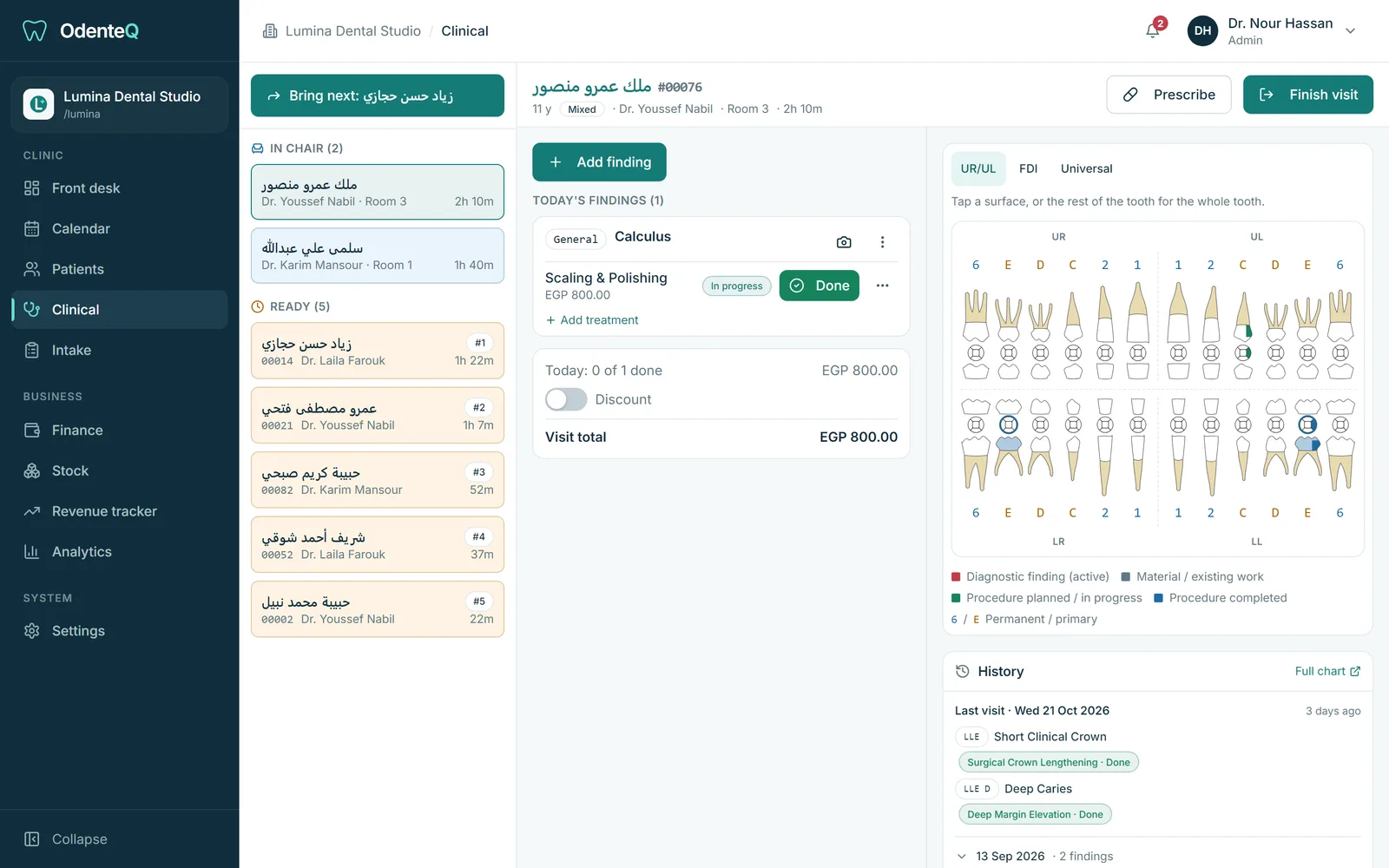
In OdenteQ’s dental chart you choose FDI or Universal for the clinic. Teeth are picked on a keypad laid out the way a dentist sees the mouth, with surfaces M, O, D, B and L, and primary teeth for children.
Questions
Which tooth numbering system is used in Egypt?
The FDI two-digit system (ISO 3950) is the standard in Egyptian dental schools and clinics, as in most of the Arab world.
What is tooth 36?
In FDI, 36 is the lower left first molar: quadrant 3 (lower left), tooth 6 (first molar). In the Universal system the same tooth is number 19.
What number is the wisdom tooth?
In FDI the wisdom teeth are 18, 28, 38 and 48. In the Universal system they are 1, 16, 17 and 32.